Why Acoustics Are Still Being Considered Too Late
For something that has such a significant impact on workplace performance, acoustics are still surprisingly often left until the later stages of a project.
- Lighting is discussed early.
- Furniture is discussed early.
- Technology is discussed early.
Acoustics, however, frequently enters the conversation only once someone realises there might be a problem.
Unfortunately, by that stage, many of the most effective and cost-efficient solutions have already become more difficult to implement.
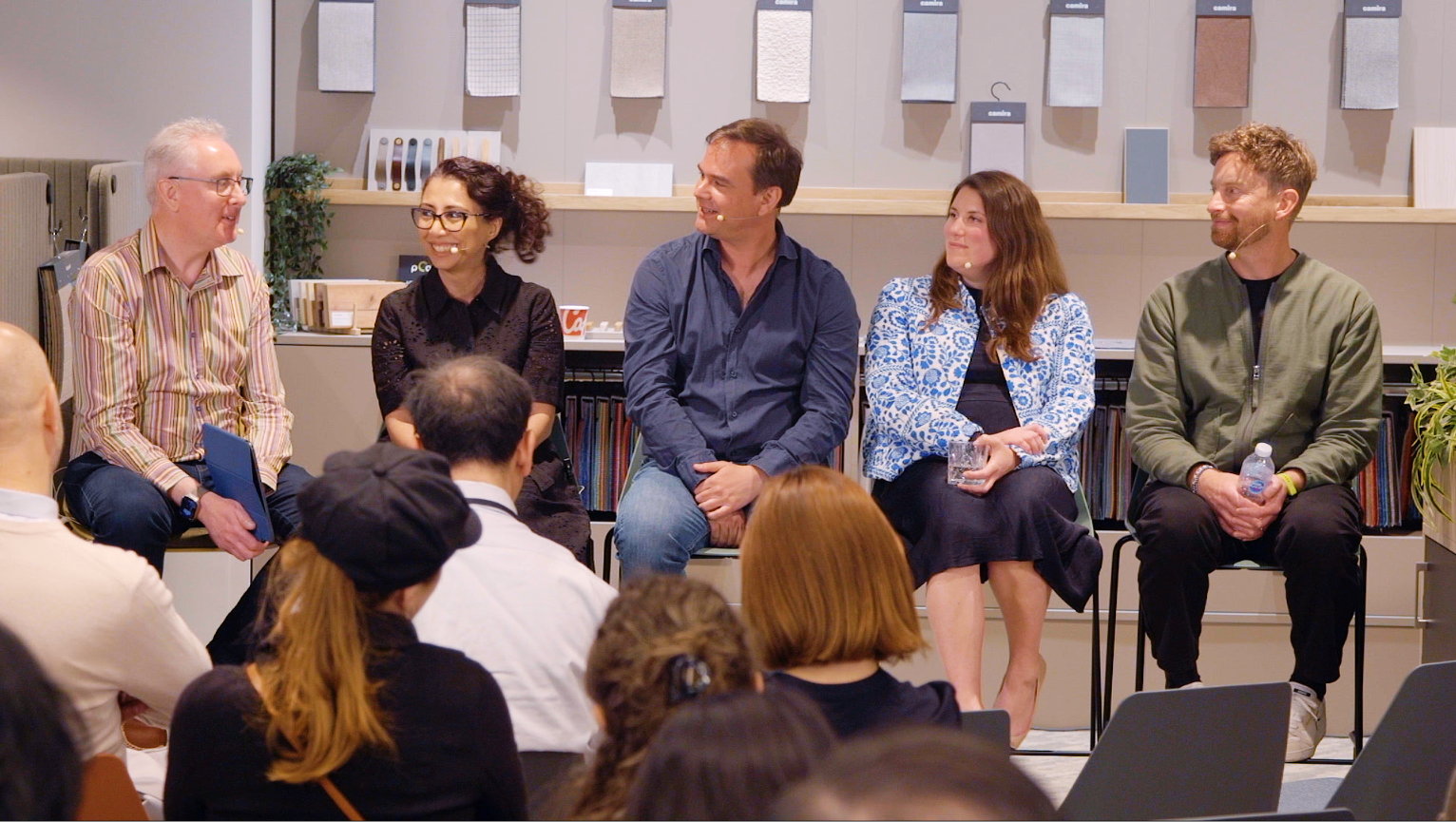
This challenge was highlighted during a recent workplace design panel discussion hosted at Clerkenwell Design Week, where designers, workplace strategists, lighting specialists and acousticians from Cundall, JLL and Area explored how successful workplaces are created.
One theme emerged repeatedly: the earlier the acoustics are considered, the better the outcome.
Most workplace projects begin with positive intentions.
- Clients want collaborative spaces.
- They want flexibility.
- They want openness.
- They want employees to enjoy coming into the office.
However, when acoustic performance is not considered from the outset, many of these aspirations can become compromised.
- Open-plan offices that encourage collaboration can quickly become noisy.
- Meeting rooms can suffer from poor speech privacy.
- Focus areas can struggle to support concentration.
- Video conferencing spaces can become difficult to use effectively.
At that point, acoustic treatment is often introduced as a corrective measure rather than an integrated design solution.
The result can be increased costs, design compromises and missed opportunities.
One of the biggest misconceptions about acoustics is that it is simply about making spaces quieter.
In reality, good acoustic design is about creating environments that support the activities taking place within them.
- A collaborative workspace should feel different from a focus area.
- A boardroom should perform differently from a breakout space.
- A video conferencing room has entirely different requirements from a social hub.
The goal is not silence. The goal is creating the right acoustic conditions for the task being performed.
When acoustics is considered early, designers can shape spaces around their intended purpose rather than attempting to solve problems afterwards.
The modern office places greater demands on acoustic performance than ever before.
- Hybrid working has transformed how people use workplaces.
- Video conferencing is now part of everyday business life.
- Teams collaborate across multiple locations.
Employees frequently move between focused work and collaborative activities throughout the day. This creates a much wider range of acoustic requirements within a single workplace. As discussed during the panel session, every meeting is now effectively a hybrid meeting. That means employees need to hear clearly, be heard clearly and communicate effectively both inside and outside the room. Acoustics has become a critical component of workplace performance rather than a specialist consideration.
Another interesting point raised during the discussion was sustainability.
There is often an assumption that better acoustic performance requires more acoustic treatment. In reality, effective acoustic design is about optimisation rather than maximisation.
Modern acoustic modelling allows consultants to identify precisely where treatment is needed and where it is not. Rather than covering every available surface, designers can often achieve the required performance with significantly less material. This approach not only improves sustainability but can also reduce project costs while maintaining excellent acoustic performance.
Less material. Better outcomes.
"It's very easy to over-engineer with acoustics. We now ask: can we achieve the same impact with half the material?"
One of the most valuable observations from the panel came from discussions around post-occupancy feedback. Many organisations conduct lessons learned sessions after project completion. However, acoustic performance is not always reviewed in detail once people have occupied the space.
This can be a missed opportunity.
Understanding how employees experience a workplace after six months or a year often provides valuable insight that can improve future projects. If a meeting room performs exceptionally well, that knowledge should be captured. If a workspace struggles with background noise, that should also inform future designs.
Acoustics should not be viewed as a one-off design decision but as part of a continuous learning process.
Successful workplace design relies on multiple disciplines working together. Architects, designers, workplace consultants, lighting specialists, engineers and acoustic consultants all bring different perspectives to a project.
The earlier those conversations happen, the easier it becomes to balance aesthetics, functionality, wellbeing and performance. Acoustics should not be something added after layouts have been fixed and finishes selected. Instead, it should form part of the conversation from the very beginning.
Early collaboration allows acoustic solutions to become integrated into the design rather than appearing as an afterthought. The result is often better performance, lower costs and a more cohesive workplace experience.
Ultimately, employees rarely walk into an office and immediately comment on its acoustic strategy.
- What they do notice is whether they can concentrate.
- Whether meetings feel productive.
- Whether conversations remain private.
- Whether the workplace feels comfortable and enjoyable to use.
These experiences are heavily influenced by acoustics. The most successful workplaces often make acoustic performance feel invisible. People simply feel comfortable within the space. That is why acoustics should no longer be treated as a late-stage consideration.
It is not simply a technical requirement. It is a fundamental part of workplace experience.And the earlier it is considered, the better the outcome for everyone.
Explore our Acoustic Product Range, request material samples, or book a CPD session with our team to learn how acoustic solutions can elevate your workplace designs Contact Us.
All of our solutions are tested to UK fire safety standards and available in a wide palette of natural shades to complement any aesthetic – from corporate to creative.
