Designing Out Distraction: The New Science of Workplace Focus
For years, organisations have been obsessed with productivity.
- Productivity software.
- Productivity metrics.
- Productivity targets.
- Productivity hacks.
Yet despite unprecedented investment in technology, many employees feel more distracted than ever.
The modern workplace has become remarkably efficient at helping us communicate.
It has become considerably less effective at helping us concentrate.
And that’s creating an interesting shift in workplace design.
Forward-thinking organisations are beginning to realise that productivity is not the metric they should be optimising.
Most people associate the attention economy with social media.
- Instagram wants your attention.
- LinkedIn wants your attention.
- Netflix wants your attention.
But increasingly, so does your workplace.
- Every Teams notification.
- Every email alert.
- Every passing conversation.
- Every phone call.
- Every movement in your peripheral vision.
Modern offices have become environments that continuously compete for attention.
The result is a phenomenon psychologists call “attention residue”.
When we switch between tasks, a portion of our focus remains attached to the previous activity. The brain doesn’t instantly reset. It carries fragments of unfinished conversations, notifications and interruptions into whatever comes next.
The more interruptions we experience, the harder it becomes to achieve meaningful concentration. This matters because the nature of work has changed. Many modern roles don’t rely on physical effort.
They rely on thinking. And thinking requires focus.
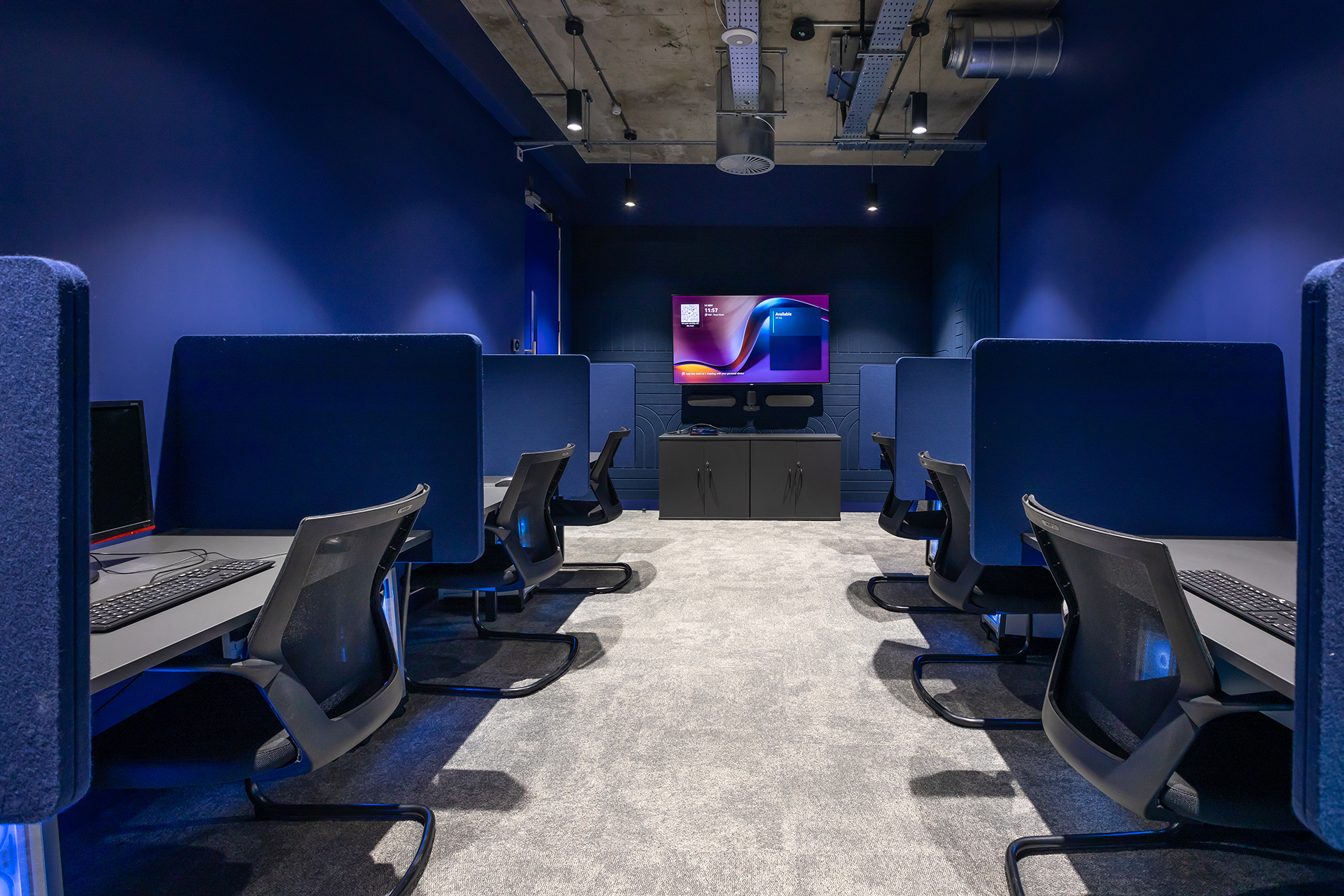
There was a time when workplace output could be measured largely by visibility.
If people were at their desks, work was happening.
Today’s economy is different.
- Innovation.
- Problem solving.
- Strategy.
- Analysis.
- Creativity.
These activities are difficult to measure directly, but they all share one common requirement: Uninterrupted attention.
The challenge is that many workplaces continue to be designed around collaboration while overlooking concentration. Collaboration is valuable. But collaboration without focus is simply noise.
The most effective workplaces are not those that maximise interaction. They are those who provide employees with control over interaction. In other words, knowing when to connect and when to disconnect.
Most organisations can calculate the cost of unused office space.
Few can calculate the cost of distraction.
Yet distraction carries significant consequences.
- It increases mental fatigue.
- It extends task completion times.
- It contributes to workplace stress.
And perhaps most importantly, it drains cognitive energy. Think of cognitive energy as the fuel that powers decision making, creativity and problem solving.
Every interruption consumes a small amount of that fuel. Individually, these moments seem insignificant. Collectively, they can transform an entire working day.
This is why many employees leave work feeling exhausted despite spending most of the day sitting down. The issue is not physical effort. It is mental fragmentation.
Of all workplace distractions, sound remains one of the most difficult to escape. You can turn away from visual distractions. You cannot stop your brain from processing sound. Humans are biologically programmed to react to voices, movement and unexpected noises. Even when we are not consciously listening, our brains continue analysing the sounds around us.
This creates a challenge for open-plan environments. A conversation occurring several metres away may seem harmless. But to a brain attempting to focus, it can represent a constant stream of interruptions.
The impact is often subtle. Employees may not identify acoustics as the problem. They simply experience increased fatigue, reduced concentration and greater difficulty completing complex tasks.
Good acoustic design is not about creating silence. It is about creating choice. Spaces for collaboration. Spaces for conversation. And equally importantly, spaces for concentration.
"The modern workplace has become remarkably efficient at helping us communicate. It has become considerably less effective at helping us concentrate."
One of the most significant workplace design conversations emerging today centres around neurodiversity. Not everybody experiences the workplace in the same way. Some individuals thrive in busy, energetic environments.
Others find constant stimulation overwhelming. For neurodivergent employees in particular, excessive noise, visual activity and sensory overload can significantly impact comfort and performance.
The traditional approach to workplace design often assumed a one-size-fits-all solution. The future workplace recognises that different people focus differently.
This has led to growing interest in:
- acoustic zoning
- quiet work areas
- retreat spaces
- sensory-conscious design
- adaptable environments
- varied workspace settings
The goal is not to eliminate stimulation. The goal is to provide options. Because inclusivity is not simply about accessibility. It is about creating environments where different people can perform at their best.
When organisations invest in workplace design, there is often a temptation to focus on what people can see.
- Feature lighting.
- Statement furniture.
- Architectural showpieces.
These elements certainly contribute to workplace identity. But some of the most important design decisions are almost invisible.
- Acoustic comfort.
- Lighting quality.
- Visual calm.
- Spatial balance.
- Environmental control.
These factors rarely dominate office photography, yet they shape the daily experience of every employee. People may not consciously notice them. But they feel them. And feeling often influences behaviour more than visibility ever will.
The future of workplace design is unlikely to be defined by bigger amenities or more extravagant features. Instead, it may be defined by something surprisingly simple:
- Removing unnecessary friction.
- Reducing distractions.
- Preserving cognitive energy.
Creating environments that support concentration as effectively as they support collaboration.
The organisations that understand this will gain an advantage that extends beyond workplace design.
Because in a world where attention has become increasingly scarce, focus is becoming one of the most valuable resources any business possesses.
And the workplaces of the future will be designed to protect it.
Explore our Acoustic Product Range, request material samples, or book a CPD session with our team to learn how acoustic solutions can elevate your workplace designs Contact Us.
All of our solutions are tested to UK fire safety standards and available in a wide palette of natural shades to complement any aesthetic – from corporate to creative.
