
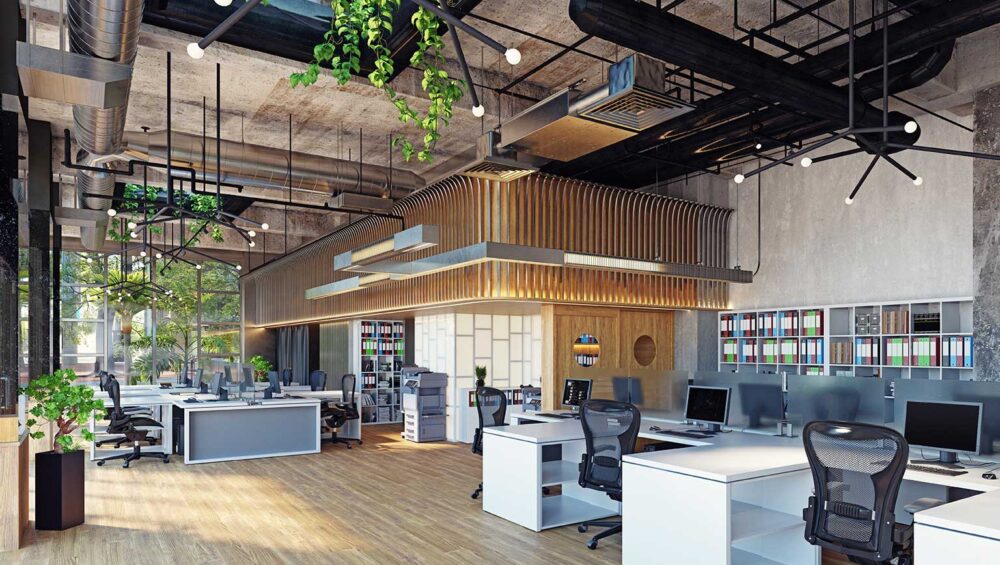
How we work has always influenced how we design the spaces we work in. From the rigid, linear layouts of the early 20th century to today’s hybrid, wellness-oriented environments, office design has continuously evolved in response to shifts in culture, technology, and business needs. At ekko Acoustics, we design acoustic solutions that complement modern working styles—but to understand where we’re heading, it helps to look at where we’ve come from.
The modern office, as we recognise it, began in the early 1900s with the advent of Taylorism. Inspired by factory efficiency, this system organised workers in rows of desks under strict supervision – an approach focused purely on productivity and hierarchy.
These early spaces were noisy, busy, and impersonal. Privacy was non-existent, and acoustic comfort wasn’t even on the radar. The focus was output, not employee well-being.

By the 1960s, workplace designers began looking for a more balanced approach. One of the most significant developments came from Herman Miller and Robert Propst, who introduced the Action Office – a flexible, modular system intended to support both individual focus and movement.
However, this concept was quickly simplified and mass-produced into the now-infamous cubicle farms of the 1980s and 90s. Cubicles became synonymous with corporate uniformity – beige panels, fluorescent lighting, and rows of partitioned desks that prioritised privacy and structure over human needs.
Acoustically, cubicles had some merit. Soft partitions offered a degree of sound dampening, and individuals were shielded from surrounding conversations. But it was hardly ideal: sound still travelled overhead, and visual isolation bred a lack of collaboration, creativity, and morale.
As the new millennium arrived, so too did the open-plan revolution. Tech startups and creative agencies drove a push towards transparency, collaboration, and flat hierarchies. Walls came down. Communal spaces popped up. Hot desking, shared tables, and breakout zones replaced rigid desks.
This marked a major cultural shift—from ‘me space’ to ‘we space’. The intention was good: remove silos, spark innovation, and make offices more democratic. But acoustically, it brought chaos.
With little in the way of physical barriers, noise became a serious problem. Conversations, phone calls, keyboard clatter, and the hum of HVAC systems filled every corner. A 2013 study by the University of Sydney found that lack of sound privacy was the most common complaint in open-plan offices. Simply put, employees could hear everything – and couldn’t focus.
At ekko Acoustics, we’ve spent years addressing these issues. Open plan offices don’t have to mean open acoustics. Thoughtful placement of ceiling baffles, wall panels, and suspended rafts can make an enormous difference to comfort, concentration, and performance.
Today, the pendulum has settled somewhere in the middle. The shift to activity-based working (ABW) recognises that no single layout suits every task. Instead, offices are designed to offer a variety of settings: quiet zones for focus, collaborative spaces for teamwork, lounges for informal meetings, and sound-insulated booths for calls.
This model reflects how we actually work: dynamically. It also supports hybrid work patterns, where employees split time between home and office.
In this environment, acoustics are essential. A noisy quiet zone is ineffective. A reverberant meeting room undermines productivity. Our acoustic solutions at ekko are designed to give designers and facilities teams the tools they need to tailor each space, enhancing functionality while supporting the overall aesthetic of the workplace.
We offer a wide range of sound-absorbing materials, including recycled felt baffles, decorative wall treatments, ceiling rafts, and timber slats. Each can be adapted to suit the brand, layout, and acoustic requirements of the space.
"Office design is no longer about desks and chairs. It’s about experience. And acoustics play a bigger role in that experience than ever before."
Alongside flexibility, there’s been a welcome shift towards well-being in office design. Employers now understand that happier, healthier employees are more engaged and more productive. This has led to the integration of biophilic elements, softer lighting, wellness rooms, and acoustically calm environments.
The pandemic accelerated this trend. As we returned to the office post-lockdown, the bar for comfort was higher. People were no longer willing to tolerate poor acoustics, harsh lighting, or noisy surroundings. They expected more from their workspaces – rightly so.
At ekko, we work closely with interior designers, architects, and project teams to bring that level of comfort to every project – creating acoustic features that enhance both form and function.
As we look to the future, several trends are clear:
Hybrid work will remain dominant, which means offices must be more purposeful and versatile.
Sustainability will continue to shape material choices and construction methods.
Technology—including AI—will influence how, when, and where we work.
Well-being will remain central to office culture, from mental health to acoustic comfort.
Office design is no longer about desks and chairs. It’s about experience. And acoustics play a bigger role in that experience than ever before.
If you’re planning your next office fit-out or refurbishment, talk to us about how acoustic design can help your space perform better for your people, your culture, and your future.
