The Acoustic Problem Nobody Talks About
Modern commercial office design has never looked better.
Today’s workplaces are filled with:
- biophilic planting
- feature lighting
- hospitality-inspired furniture
- café breakout spaces
- premium finishes
- wellness areas
- flexible collaboration zones
Yet despite all of this investment, many employees still describe offices as tiring, distracting, and difficult places to work.
Why?
In many cases, the problem is not what people see.
It is what they hear.
One of the biggest issues in modern workplace design is also one of the least visible: poor acoustics.
Open-plan layouts, exposed ceilings, glass partitions, polished concrete, collaborative spaces, and hybrid working behaviours have dramatically increased workplace noise levels. The result is an environment where concentration becomes harder, conversations overlap, and employees experience constant low-level sensory fatigue.
Most people cannot immediately identify acoustics as the cause.
They simply describe the space as:
- stressful
- chaotic
- draining
- difficult to focus in
- mentally exhausting
That is the challenge with acoustic discomfort — it is often felt long before it is consciously recognised.
The modern office now supports activities it was never originally designed to accommodate simultaneously:
- Teams calls
- Video meetings
- Collaborative workshops
- Social interaction
- Quiet focused work
- Informal meetings
- Hot desking
- Phone calls at desks
Everyone is operating within the same open environment, often with very little acoustic separation.
A space may look visually stunning, but if sound reverberates excessively or speech travels too freely, the workplace experience quickly deteriorates.
This is why many beautifully designed offices still fail to function effectively day-to-day.
Workplace discussions often focus heavily on productivity, but acoustics affect something more fundamental: cognitive energy.
Constant background noise forces the brain to continuously filter information:
- nearby conversations
- ringing phones
- keyboard noise
- video calls
- footsteps
- reverberation
Even when employees appear to be coping, this ongoing sensory processing creates fatigue over time.
The result is often:
- reduced concentration
- shorter attention spans
- increased stress
- mental exhaustion
- reduced workplace satisfaction
Ironically, companies can invest heavily in wellbeing initiatives while overlooking one of the biggest daily environmental stressors employees experience.
The most successful modern workplaces are not necessarily the quietest. They are the ones designed with different acoustic experiences for different activities.
This is where acoustic zoning becomes critical.
Modern offices increasingly require:
- quiet focus areas
- collaborative zones
- informal social spaces
- private meeting environments
- phone booths
- decompression spaces
Each area requires a different acoustic approach.
Good acoustic design is no longer about simply reducing noise. It is about shaping how spaces feel and function.
"A workplace may look impressive on a showroom tour, but if it feels acoustically stressful after several hours, employees will naturally avoid spending time there."
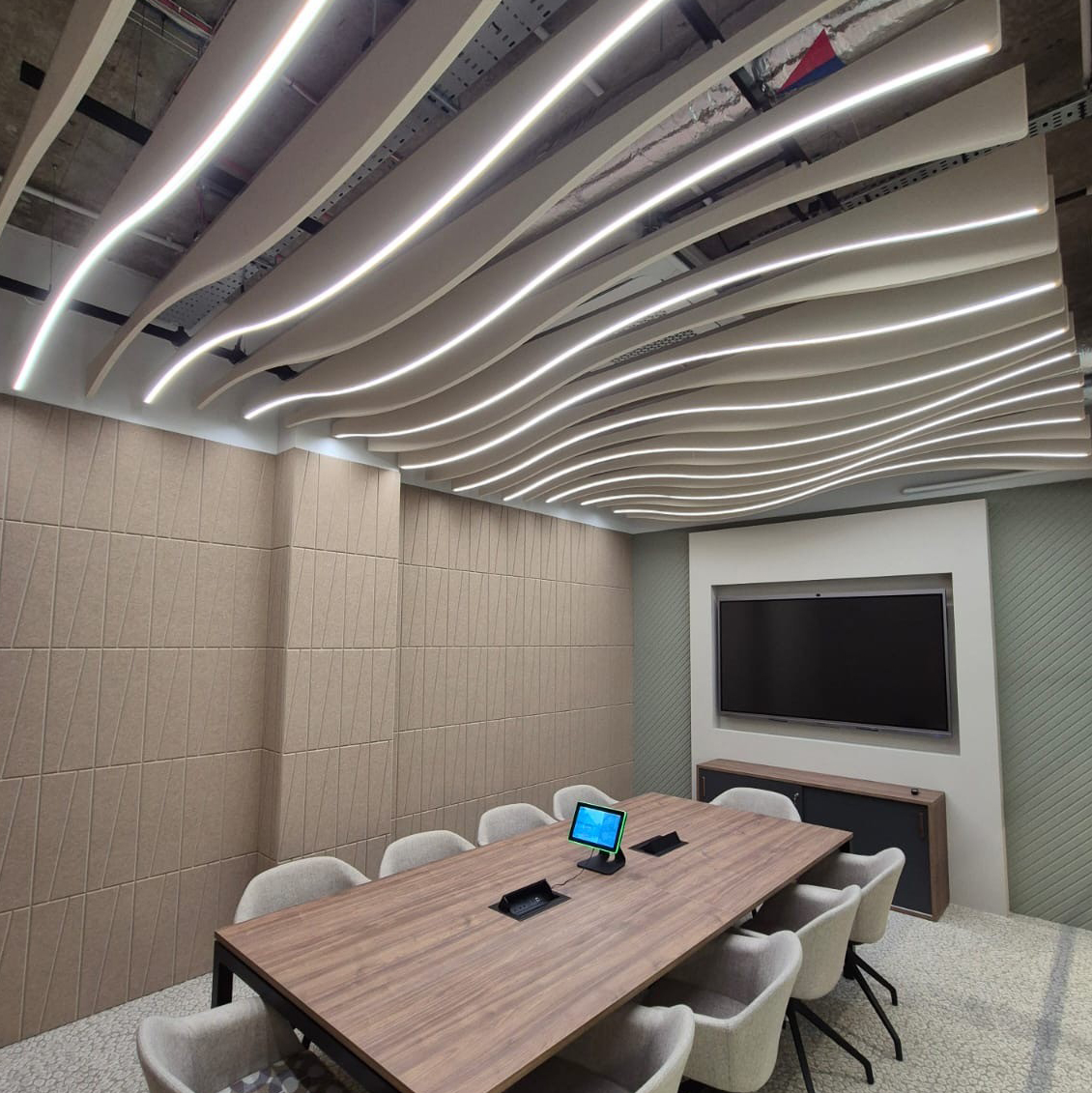
One of the biggest shifts in recent years is that acoustic solutions are no longer treated as purely functional add-ons.
Architects and designers increasingly want acoustic treatments that contribute to the overall visual identity of a space.
This has led to growing demand for:
- acoustic felt ceiling systems
- sculptural baffles
- decorative wall panels
- acoustic lighting integration
- timber acoustic slats
- feature ceiling rafts
- bespoke acoustic installations
Acoustic products are becoming integrated design elements rather than something hidden away after the fit-out is complete.
Hybrid working has changed employee expectations permanently.
People became used to having greater control over their environment at home:
- quieter surroundings
- privacy
- reduced interruptions
- control over lighting and sound
When employees return to noisy, reverberant workplaces, the contrast becomes far more noticeable than it once was.
The modern office is no longer competing with older offices.
It is competing with the comfort and control people experienced working remotely.
That makes acoustic comfort far more important than many organisations realise.
The best workplace environments today understand something simple:
People respond emotionally to spaces before they evaluate them rationally.
A workplace may look impressive on a showroom tour, but if it feels acoustically stressful after several hours, employees will naturally avoid spending time there.
The offices that succeed long-term are the ones that feel:
- calm
- comfortable
- balanced
- easy to work in
- easy to communicate in
That experience is shaped as much by sound as by aesthetics.
At Ekko Acoustics, we work with designers, architects, and fit-out specialists to create acoustic solutions that support both workplace performance and visual design — helping modern offices sound as good as they look.
