The Office as a Product: Designing Workspaces Like User Experiences
For decades, offices were designed like storage.
Rows of desks. Suspended ceilings. A few meeting rooms named after mountains nobody had climbed. A reception desk large enough to imply importance but rarely large enough to improve anyone’s day.
The assumption was simple: people needed somewhere to sit while they worked.
That assumption no longer survives contact with reality.
Today, the average employee has something previous generations never had:
choice.
They can work from home. From cafés. From trains. From co-working spaces. From kitchen tables engineered through trial and error into surprisingly effective command centres. The office is no longer the only place where work happens.
Which means the office now faces a profoundly uncomfortable commercial question:
Why should anyone bother coming in?
And that changes everything.
Because once people have a choice, the office stops being a piece of real estate and starts becoming something else entirely:
A product.
And like any product, it succeeds or fails based on user experience.
The best commercial interiors are no longer simply “designed spaces”. They are behavioural systems. Carefully engineered environments that influence mood, focus, interaction, creativity, identity and energy — often invisibly.
The companies winning the return-to-office battle are not demanding attendance.
They are designing desirability.
For years, workplace strategy obsessed over efficiency.
More desks per square metre.
More density.
More “agile” working.
More collaboration.
But there’s a problem with designing purely for measurable efficiency:
Humans are astonishingly irrational creatures.
People do not fall in love with efficiency.
Nobody walks into a beautifully designed hospitality space and says:
“Excellent circulation ratios.”
What people remember is feeling.
The atmosphere.
The energy.
The ease.
The social confidence a space gives them.
The subtle psychological cues that say:
“You belong here.”
Great office design operates in exactly the same way.
The irony is that some of the most commercially effective workplace decisions initially look inefficient on paper.
A quieter corner.
A softer acoustic environment.
Warmer lighting.
Less visual clutter.
More varied spaces.
Lower sensory fatigue.
None of these things show up neatly on a spreadsheet.
Yet they fundamentally alter how people behave inside a space.
And behaviour is ultimately what companies are actually buying.
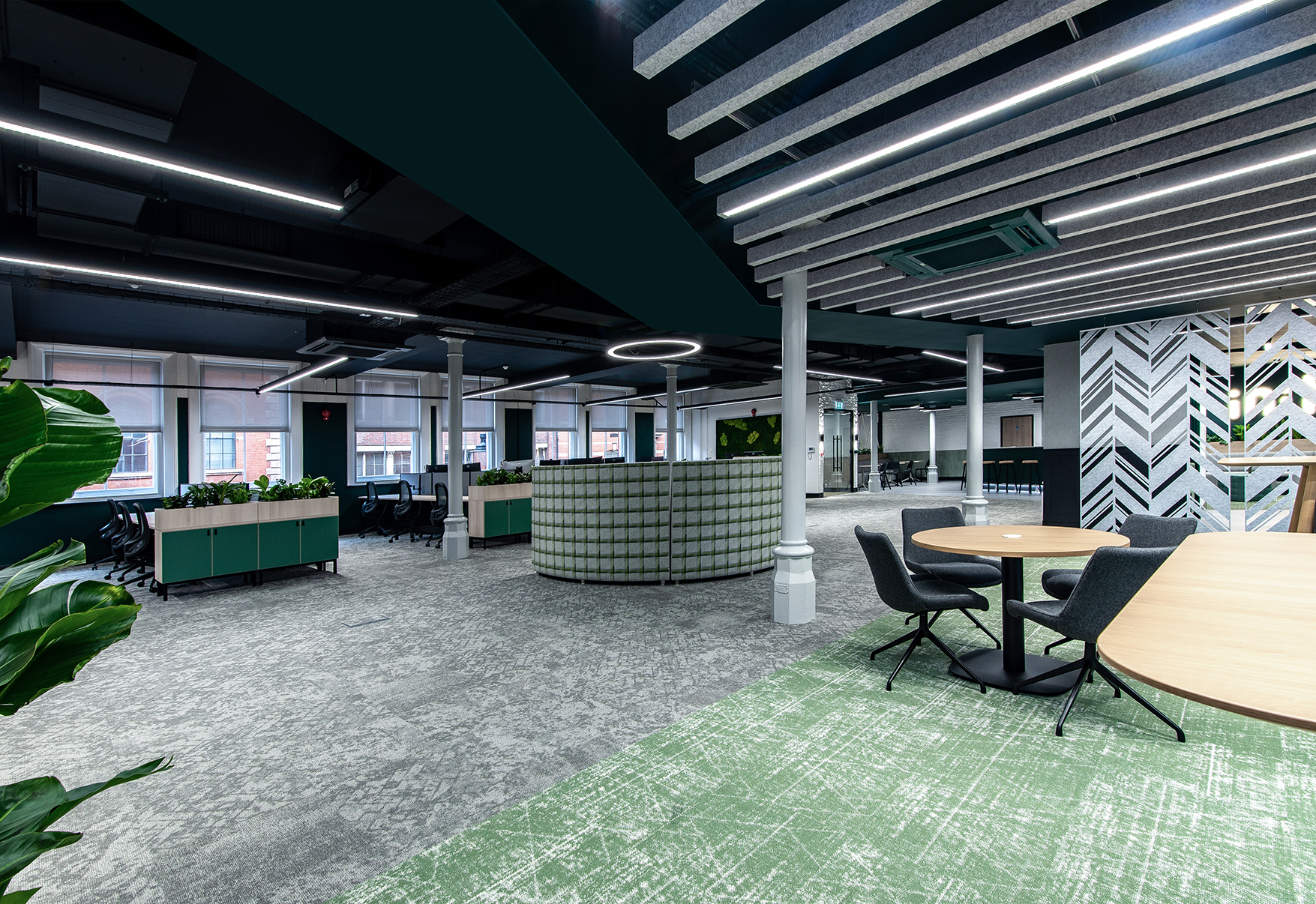
Most offices are still designed around visibility.
Modern offices should be designed around cognitive stamina.
That’s a very different brief.
The biggest problem in many commercial interiors today is not a lack of collaboration.
It’s exhaustion.
Visual exhaustion.
Acoustic exhaustion.
Decision exhaustion.
Interruptive exhaustion.
Open-plan offices accidentally created environments where the human brain is permanently running background threat analysis.
Who’s behind me?
Who’s listening?
Can I focus?
Should I look busy?
Where can I take a call?
Why is somebody reheating fish again?
Poor acoustics are particularly destructive because noise is uniquely invasive.
You can close your eyes.
You cannot close your ears.
And unlike obvious design failures, acoustic fatigue is often subconscious. People simply leave work feeling more drained without fully understanding why.
This is where modern workplace design becomes fascinating.
The highest-performing offices are increasingly designed not around appearance alone, but around friction reduction.
Reducing sensory friction.
Reducing cognitive friction.
Reducing social friction.
In other words:
making work feel psychologically easier.
That may sound soft.
It is actually commercially brutal.
Because energy is productivity.
There is a curious truth in commercial interiors:
The features people notice first are rarely the features affecting them most.
Everyone notices the statement staircase.
Almost nobody notices the reverberation control that makes conversation comfortable.
Or the lighting temperature that reduces fatigue at 4pm.
Or the layered environments that allow different personality types to work effectively.
And yet these invisible layers are often the difference between a workspace people tolerate and one they actively prefer.
This is why the future of workplace design belongs increasingly to integrated thinking.
Not isolated products.
Not disconnected design gestures.
But environments where acoustics, lighting, materials, spatial planning and behavioural psychology work together as a single experience.
The office becomes less like a static container and more like a carefully designed operating system.
Look at the world’s most desirable modern workplaces and something becomes obvious:
They increasingly borrow their emotional cues from hospitality.
Hotels understand something offices forgot years ago:
people make emotional decisions first and rational decisions second.
Nobody remembers hotel room square footage with emotional intensity.
They remember how the space made them feel.
Calm.
Important.
Comfortable.
Inspired.
Relaxed.
Socially confident.
The same psychology is now reshaping workplace design.
That’s why we’re seeing:
- softer materials
- layered lighting
- acoustic zoning
- residential influences
- biophilic elements
- lounge-style collaboration spaces
- reduced visual harshness
- more human-scaled environments
Not because offices are becoming less professional.
Because they are becoming more psychologically intelligent.
"The office is no longer competing against the office next door. It is competing against home, autonomy, comfort and control."
This is the critical shift many organisations still misunderstand.
Your office is no longer competing against the office next door.
It is competing against:
- home
- autonomy
- convenience
- comfort
- control
- silence
- flexibility
And home has become an extraordinarily strong competitor.
Which means transactional workplaces are dying.
If people commute only to sit in a louder, harsher, more distracting version of their own home setup, the office has failed before the working day even begins.
The future belongs to spaces that offer something emotionally, socially or cognitively superior to remote work.
Connection.
Energy.
Identity.
Creativity.
Belonging.
Focus.
Serendipity.
These are experiential qualities — not facilities-management metrics.
The most successful commercial spaces increasingly understand a subtle but powerful truth:
People return to places they emotionally remember.
That applies to restaurants.
Hotels.
Retail.
And now offices.
Memorable workplaces create stories.
The dramatic lighting moment in reception.
The unexpectedly calm meeting space.
The acoustic comfort people can’t quite explain but immediately feel.
The breakout space people naturally gravitate toward.
These moments shape culture more effectively than most internal branding exercises ever will.
Because culture is not what companies say.
Culture is what spaces repeatedly encourage people to feel.
The next era of commercial design will belong to companies that understand this:
Workplace design is no longer primarily about accommodation.
It is about persuasion.
Persuading people to collaborate.
To stay longer.
To think more clearly.
To feel connected.
To identify with a company.
To do better work.
The office of the future will not win because it contains desks.
It will win because it understands humans.
And in the end, that may be the ultimate competitive advantage.
Explore our Acoustic Product Range, request material samples, or book a CPD session with our team to learn how acoustic solutions can elevate your workplace designs Contact Us.
All of our solutions are tested to UK fire safety standards and available in a wide palette of natural shades to complement any aesthetic – from corporate to creative.
